
Even though more and more laboratories now work under a biosafety cabinet (BSC) or a hood, most microbiology labs still use a Bunsen burner to protect their work.
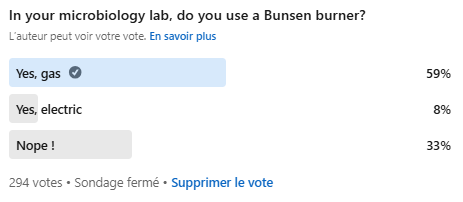
What is a Bunsen burner actually used for in a microbiology lab?
The Bunsen burner as we know it today was invented by… Peter Desaga, Robert Bunsen’s assistant.
And Robert Bunsen was actually a… chemist. It hurts us a little to admit it.
Maybe that explains why the Bunsen burner is not always as effective as we think in microbiology!
A Bunsen burner produces a very hot flame, around 1,200°C, using gas. Electric burners also exist.
In microbiology, the flame is mainly used for two things:
- Flaming, or more precisely sterilizing, instruments such as inoculating loops and straight wires between manipulations.
- Creating a “sterile zone” of around 10 to 15 cm around the flame, allowing microbiologists to handle plates and tubes while reducing the risk of contamination.
When it comes to flaming instruments, we are pretty confident that it works well… otherwise we would probably see a lot more contamination during isolation.
But many microbiologists are still sceptical (if not aseptic 😉) about how effective this aseptic cone really is, or even whether it truly exists.
- If it does exist, how large is the aseptic zone: 10 cm, 20 cm, 30 cm around the Bunsen burner?
- Is this airflow really free from microorganisms?
In theory, how does the Bunsen burner aseptic cone work?
The theory is based on the air movement created by the heat of the flame.
Hot air rises above the burner and creates an upward airflow. The idea is that this airflow may carry away some of the dust and microorganisms present in the air, reducing the number that can settle on an open Petri dish or container nearby.
But the mechanism is probably more complex than it sounds.
For hot air to rise, surrounding air must also be drawn toward the heated area. And this air can also carry microorganisms.
So the real question is: does this airflow actually reduce the number of microorganisms that settle on our samples and equipment?
That is exactly what we wanted to test.
So we created a worldwide collaborative study to test this famous “aseptic cone.”
And 126 microbiology laboratories took part!
The conclusions are quite surprising… We’ll let you discover them by downloading the full study below.