During our visits to microbiology laboratories, we rarely see results reported with measurement uncertainty.
Yet every time we look into the lab next door… the chemistry lab, almost all results are expressed with these famous uncertainties.
And our LinkedIn poll seems to show the same thing:
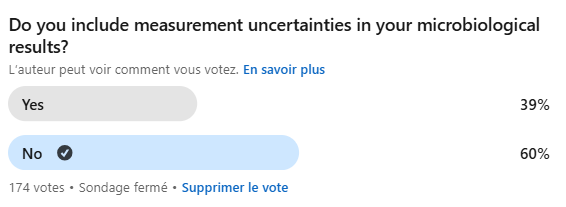
Only a minority of microbiology laboratories report their results with measurement uncertainty.
So why would microbiology be any different?
Maybe because in microbiology we only have… certainty?! 😉
To solve this mystery, we spoke with several laboratories.
And even if we were a bit reluctant at first to talk about maths and statistics… we (almost) started to enjoy it.
Most importantly, it helped us better understand many things in microbiology.
What is measurement uncertainty in microbiology?
When we count bacteria in a sample, the value obtained on a Petri dish naturally contains some error.
This error can be modeled using the Poisson distribution.
But this error should not make us forget that, in microbiology, results can also be influenced by several other sources of uncertainty, including:
- Manpower
- Machine
- Materials
- Methods
- Measurement
These are known as the “5 Ms”.
This is what we call measurement uncertainty.
How is measurement uncertainty calculated in microbiology?
Now that we roughly understand what measurement uncertainty is, let’s look at how it is calculated.
To do this, we will present the three types of uncertainty most commonly used in food microbiology.
Distribution uncertainty
This is the minimum uncertainty that should be considered.
It is modeled using the famous Poisson distribution (does that sound familiar?), which takes into account the random distribution of bacteria in a sample.
Example: You have a tube containing 100 bacteria in 10 mL of liquid.
In theory, this means 10 bacteria per mL.
But if you pipette 1 mL ten times, you will not always obtain exactly 10 colonies on your Petri dish.
You may observe 7, 8, 9, 10, 11, 12, or 13 colonies. This is called distribution uncertainty.
Using the Poisson distribution, we can apply a formula to our results to calculate this distribution uncertainty.
Let’s take a practical example. If you observe 25 colonies on your Petri dish, the Poisson distribution could give a result between 15 and 35 CFU with a 95% probability.
Once again, this is the minimum uncertainty that should be considered. If we want to go further, we can also calculate other sources of uncertainty.
Technical uncertainty
There are several ways to calculate technical uncertainty.
In practice, the laboratory is asked to analyze at least ten homogenized samples with several repetitions while changing as many parameters as possible.
Here are some examples of parameters that can be changed:
- 2 operators
- 2 pipettes
- 2 incubators
- 2 reagent batches
- etc.
Using the results obtained, it is then possible to calculate the technical uncertainty.
Matrix uncertainty
This uncertainty comes from the fact that matrix homogenization is always imperfect and varies from one matrix to another.
The homogenization of spring water will not be the same as the homogenization of minced meat.
As a result, each matrix will have its own uncertainty.
We will come back to this point later in the article.
What do the standards say about measurement uncertainty?
The approach may differ depending on the standards and the field in which you work:
- Is your laboratory accredited to ISO 17025 or not?
- In which field do you work? Pharma, cosmetics, food, water?
Measurement uncertainty in food microbiology
In the food industry, laboratories generally refer to ISO 19036 (Measurement uncertainty for quantitative determinations).
This standard proposes estimating measurement uncertainty using three main sources of uncertainty:
- Technical uncertainty (experimentally measured in the laboratory): Utech
- Matrix uncertainty (for some well-known matrices, databases already exist with uncertainty values): Umatrix
- Distribution uncertainty linked to the Poisson distribution: Upoisson
These different uncertainties are then combined in a formula (a slightly scary one… although we have seen worse 😉).
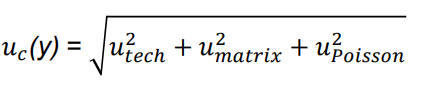
The uncertainty evaluation must of course be updated regularly.
Measurement uncertainty in the pharmaceutical industry
In the pharmaceutical industry, things are simpler… for once!
Uncertainty is not calculated depending on the laboratory, the method, or the matrix.
There is a general rule described at the end of chapter 2.6.12 of the European Pharmacopoeia (Microbiological examination of non-sterile products: microbial enumeration tests).
It states that:
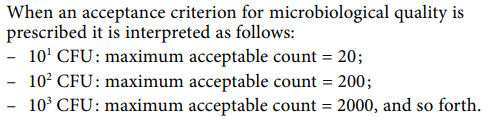
In the pharmaceutical industry, uncertainty is therefore not applied to the result itself, but to the acceptance limit.
This can lead to some surprising situations.
For example, if a test has an acceptance criterion of 100 CFU, and you observe 150 colonies on your Petri dish, the product may still be considered compliant (since it remains below 200 CFU).
Practical example of measurement uncertainty calculation in microbiology
We don’t know about you, but for us, without a practical example… it is hard to visualize.
So let’s take an example:
Total count analysis in a simple liquid matrix, with an acceptance limit of 100 CFU/mL.
Method: 1 mL pour plate on total count agar.
Result without uncertainty: 90 colonies → 90 CFU/mL. The result is below the limit of 100 CFU/mL, so the product is considered compliant.
Result with uncertainty: 90 CFU [71 ; 109](rounded)
To simplify this example, we will only consider the uncertainty linked to the Poisson distribution (the minimum uncertainty).
But then… which result should be reported? 90, 71, or 109 CFU?
And more importantly, is the acceptance limit exceeded?
We can imagine three different approaches:
- We do not take uncertainty into account → reported result: 90 CFU/mL – COMPLIANT
- We consider the risk for the consumer (we do not want to risk contaminating the consumer) → reported result: 109 CFU/mL – NON-COMPLIANT
- We consider the financial risk for the company (we do not want to lose a batch) → reported result: 71 CFU/mL – COMPLIANT
And you, which approach would you choose?
Measurement uncertainty in the “real life” of laboratories
To write this article, we spoke with many laboratories: accredited and non-accredited labs, working in pharma, water testing, and food microbiology.
Most of them admitted that they do not really take uncertainty into account, because uncertainties are often very large and raise many questions regarding acceptance limits.
The accredited laboratories we interviewed all have data related to measurement uncertainty, but they generally do not display it on certificates of analysis.
However, if a client requests it, they are able to quickly provide results including uncertainty.
In the pharmaceutical industry, the laboratories we interviewed were aware of the existence of the “factor 2” rule, but most told us they never use it.
Some only use it in specific situations, for example when microbiology results are just above the limit and the product is considered “valuable” and they really want to “save” the batch.
Conclusion on measurement uncertainty in microbiology
In microbiology, just like in chemistry, measurement uncertainty definitely exists!
The difference is that, in microbiology, uncertainties are much larger, which often makes decisions about batch compliance difficult.
This is probably why they are rarely used in routine practice.
In any case, this reminds us of one important thing:
In microbiology, we should always keep a critical view of the results. We should not blindly trust the number of colonies observed on a Petri dish to make a decision.
Behind every result, there is always some interpretation and reflection involved (and it is not always easy)… but that is also what makes this science so fascinating!
Here, we talked about technical uncertainty, Poisson uncertainty, and matrix effects… but we left out one very important parameter: we are working with living microorganisms.
Some microorganisms will grow, while others will not because they are weakened or stressed. And above all, there are many different microorganisms, and they do not all behave the same way!
And all of this adds even more uncertainty.
We would like to thank Philippe Caillaud (statistics expert at AFNOR, CEFIRA, and COFRAC), who greatly helped us write this article and made statistics a little more “sexy” in our eyes 😉