
This article, created with the support of Oxy’Pharm, explores the challenges and practices of disinfection in microbiology laboratories.
Properly and efficiently disinfecting a laboratory is not as simple as it seems.
Fortunately, solutions now exist that make the process both easier… and highly effective.
We met with a user of an airborne disinfection method (ASD – Airborne Surface Disinfection), who explains how this technology helps maintain a laboratory that is not only clean… but most importantly, properly disinfected.
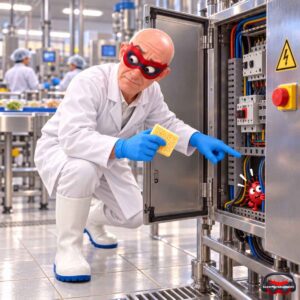
For confidentiality reasons, the SuperMicrobiologist we interviewed preferred to remain anonymous… or rather, keep the mask on!
“For results to truly reflect the real contamination level of the samples, there must be as little environmental flora as possible, otherwise it may bias the results (risk of false positives).”
Laboratory presentation and contamination risks
Can you introduce the microbiology laboratory where you work?
I currently work in an internal laboratory within the food industry. The laboratory covers around 150 square meters and has a team of 7 people (1 manager, 4 laboratory technicians, and 2 multi-skilled technical and administrative technicians).
Why is it important to properly clean and disinfect a laboratory?
The role of a food microbiology laboratory is to detect and enumerate different types of flora in food samples.
For the results to accurately reflect the real contamination level of the samples, there must be as little environmental flora as possible that could bias the results (risk of false positives).
That is why it is essential to maintain a clean laboratory and work under aseptic conditions.
“ASD is complementary to manual disinfection. It makes it possible to reach hard-to-access areas… without requiring additional labor time for disinfection.”
Routine cleaning and disinfection in the laboratory
What cleaning and disinfection procedures do you use in your laboratory?
In our laboratory, we use a degreaser (similar to Ajax) and a detergent-disinfectant for the major cleaning performed on Friday evenings.
During the week, benches and equipment are cleaned every evening using disinfectant wipes. An additional disinfection step is then carried out using a spray disinfectant (with a contact time of several minutes).
Several times a day, targeted disinfection with 70% ethanol is also performed in case of accidental spills or when products or sample matrices fall onto the bench.
In addition to these daily and weekly cleaning and disinfection procedures, we use the Nocospray system for airborne disinfection (ASD cycle with the Oxy’Pharm solution).
Why do you use an airborne surface disinfection (ASD) system?
ASD complements manual disinfection. It allows hard-to-reach areas to be treated, helps decontaminate the environment, and limits microbial growth without requiring additional labor time for disinfection.
How does it work in practice?
For several minutes, H₂O₂ is sprayed into the air to decontaminate the surrounding environment. The product then breaks down into H₂O and O₂, without damaging equipment or posing risks to people.
This treatment is carried out on Saturdays, after on-call activities are completed, so the product has time to act over the weekend without causing respiratory discomfort when the teams return, once the product has fully degraded.
Which model do you use, and what volume do you treat?
We use the Nocospray by Oxy’Pharm. In general, a preventive dosage is applied (1 mL per cubic meter). In case of contamination, a curative treatment can be used (3 mL per cubic meter, or even 5 mL per cubic meter in cases of heavy contamination).
What is the advantage of using ASD for disinfection?
Without ASD, disinfection is entirely manual. It can be long, tedious, labor-intensive, and still imperfect (some corners remain difficult to reach).
In contrast, ASD provides a more complete disinfection process.
The disinfectant fog complements manual cleaning on already clean surfaces and reaches difficult access areas without requiring additional labor time.
However, ASD will never replace manual cleaning before disinfection: H₂O₂ cannot disinfect underneath biofilms. It must therefore always be used in addition to conventional manual cleaning.
In routine operations, how often are cleaning and disinfection performed?
In routine conditions, cleaning and disinfection are performed every day on work areas (benches, instruments, etc.). Additional cleaning may also be carried out several times during the day in case of spills or contamination of a specific area.
An external company also cleans the floors every evening.
Enhanced cleaning is performed at the end of the week over a wider area, including chairs, some furniture, and the walls of the BSC hood.
The ASD cycle is launched on Saturdays after activities have ended, before the weekend (once nobody will enter the laboratory for several hours).
Finally, monthly and yearly cleaning plans are also implemented.
Certain areas located farther from the benches, such as table legs, inside cabinets, or storage shelves, are cleaned less frequently (once a month, once every three months, etc.).
“Total flora limits may be set at < 50 or < 100 CFU/sample on a bench, but < 5 CFU/sample inside a BSC hood.”
Environmental monitoring in the laboratory
What types of microbiological sampling do you perform?
In our laboratory, we monitor the environment using contact plates, wipes, and swabs for surface testing.
We also monitor the air using plates or bottles left open near the workstation during handling activities (for example, for 30 minutes).
In addition, consumables and equipment are also checked (diluents, culture media, tips, sterile pipettes, etc.).
How often do you perform these tests?
In our laboratory, some controls are performed daily, weekly, or monthly, depending on whether the control point is considered critical (close to handling areas) or non-critical (farther from handling areas).
What is interesting is that each laboratory can define the frequency of its controls according to its own risks and identified zones.
Are there thresholds (for pathogens and total flora) that trigger specific cleaning or disinfection actions?
Each laboratory must define its own thresholds, as well as the associated corrective and curative actions, depending on the microorganisms detected and the affected areas.
For example, total flora limits may be set at < 50 or < 100 CFU/sample on a bench, but < 5 CFU/sample inside a BSC hood.
For a pathogen such as Salmonella, the target is generally “not detected”.
“It can be difficult for teams to carry out immediate enhanced cleaning… because it requires time, while routine work still has to continue in parallel.”
Corrective cleaning and disinfection in the laboratory
If thresholds are exceeded, what does that mean for cleaning procedures?
Each laboratory defines its own corrective and curative actions depending on the non-conformities observed. In our laboratory, several actions are possible.
For common flora (total flora), if the compliance threshold is exceeded on two consecutive controls, an additional cleaning operation may be performed, followed by a verification test to confirm its effectiveness.
In the case of pathogenic flora detection, immediate enhanced cleaning of the area is implemented, followed by new sampling to verify the effectiveness of the corrective actions.
Is it difficult for teams to perform enhanced cleaning?
It can indeed be complicated for teams to carry out immediate enhanced cleaning.
On one hand, it requires additional time, and on the other hand, action must be taken quickly while routine laboratory work still has to continue at the same time.
That is why it is better to avoid these emergency situations as much as possible and focus on effective preventive cleaning procedures.
Do you use ASD for immediate enhanced cleaning?
Immediate enhanced cleaning can be combined with an airborne disinfection treatment (ASD) when the situation justifies it (for example, when a wider contamination issue is suspected).
However, ASD cannot be implemented immediately after cleaning because the laboratory must be evacuated during and after the treatment.
On the other hand, it can be performed later the same evening, once nobody remains inside the laboratory.
“The solution is very easy to use. The device is simple to handle: you just need to screw on a 1 L bottle of Nocospray solution.”

Additional questions about the Nocospray solution (ASD)
How long after use can the laboratory be re-entered?
With the Nocospray by Oxy’Pharm, the treatment itself can last from 10 to 30 minutes, depending on the dosage and room size. The time required for H₂O₂ to degrade into H₂O and O₂ is generally between 2 and 3 hours (depending on the room size and dosage).
Is there any odor?
If someone enters the room too early, there may be some respiratory discomfort or irritation caused by the sprayed product, but without serious danger. A hydrogen peroxide smell may also be noticeable, similar to a swimming pool odor, which gradually disappears.
Is Nocospray easy to use and maintain?
The solution is very easy to use. The device itself is simple to handle: you only need to screw on a 1 L bottle of Nocospray solution.
Once powered on, the user selects the volume to be delivered using the touch button (depending on the room volume and selected dosage). A long press activates a 30-second alarm before the fine-droplet spraying begins, giving enough time to leave the room.
You simply need to make sure the doors are closed and that the device is pointed toward the center of the room to ensure proper diffusion.
Can it be used to disinfect a BSC or an incubator?
Absolutely. Since the diffusion is airborne and homogeneous, you simply need to open the incubator door or leave the BSC open for the area to be properly disinfected.
Does the disinfectant (H₂O₂) damage equipment?
The reagent disinfects equipment without causing corrosion, provided the recommended doses are respected. These systems are also used in sensitive environments such as dental clinics or operating rooms, where electronic equipment is everywhere.
In addition, after several years of weekly use (at 1 or 3 mL per cubic meter), I have personally observed no equipment degradation linked to corrosion in my laboratory.
So now you know a little more about the cleaning and disinfection routines used in a food microbiology laboratory:
- a routine disinfection procedure
- regular microbiological monitoring
- an enhanced disinfection procedure in case of “contamination”
We would like to thank this masked SuperMicrobiologist, who agreed to share their experience with us.
LEARN MORE ABOUT Oxy’Pharm
Oxy’Pharm is a French company specialized in bio-disinfection solutions and infection risk control for sensitive environments.
The technology developed by Oxy’Pharm is based on Airborne Surface Disinfection (ASD), an automated process designed to disinfect an entire area, including hard-to-reach zones.
The system combines an automated diffusion device, such as the Nocospray system, with a hydrogen peroxide-based disinfectant from the Nocolyse range. The solution is transformed into a gas made of ultra-fine micro-particles, ensuring homogeneous distribution across all surfaces.
This technology enables complete, reproducible, and residue-free disinfection while remaining compatible with sensitive and electronic equipment. The cycles are automated, traceable, and compliant with major airborne disinfection standards, including EN 17272.
Oxy’Pharm solutions are used in hospitals, pharmaceutical facilities, biotechnology laboratories, veterinary environments, and industrial sites for the decontamination of laboratories, cleanrooms, production areas, incubators, and biological safety cabinets.
In addition to the Nocotech ASD technology, Oxy’Pharm also offers HOClean ecological disinfection solutions, Sanivap steam bio-cleaning equipment, Glosair automated bio-disinfection systems with monitoring, RFID traceability, and scheduling functions, as well as AlphaClean instrument washers, providing a complete approach to hygiene and infection risk management.
Should equipment be covered during sterilization to protect against H2O2? Does it actually affect them?
What is the correct concentration for sterilization?
I worked for a pharmaceutical company for 10 years and I didn’t cover the equipment. I sterilized the Biosafety device from the inside without any problems. However, I now work in a food company lab, and they cover the equipment with plastic bags. What is the correct method?
Hi Mohamed,
This is a very good question. The lab we interviewed does not use plastic bags to protect the equipment. They have been using it for qiete a long time and it does not seems to be an issue so far.
Maybe it is just a question of droplet size or concentration.
We will ask the supplier and hope he can answer to your question here.
Hi,
Thank you for your interest in our technology.
First, it is important to note that Nocospray is used for disinfection, not sterilization.
The dosage depends on the product used. In the Nocospray range, it is typically between 3 and 7 mL/m³.
Regarding equipment, it does not need to be covered during the disinfection process. Nocospray does not produce liquid droplets; thanks to its heated and ionizing turbine, the disinfectant is dispersed as a very fine dry fog that behaves like a gas. This allows complete room coverage without causing corrosion or damage to equipment when used according to our recommendations.
For this reason, laboratory equipment, including biosafety cabinets, is usually disinfected without being covered.
Please let us know if you have any further questions.
Hi Oxy’Pharm,
Thank you very much for taking the time to respond to this question. It is crytal clear now !!
As a microbiologist in the food industry, I found this article very insightful. Can I use 70% ethanol as a disinfectant spray? What would you recommend?
Hello,
Thank you for your kind words. 70% ethanol is widely used in the labs. Make sure you use the right quantities and the contact time.