Key takeaways
- 126 laboratories took part in the experiment.
- At the 5 distances tested, no reliable protective effect of the Bunsen burner was detected.
- We did not identify any clear “protective distance” around the burner.
- This does not mean that the Bunsen burner is useless: our experiment has several important limitations and did not test flame sterilization of equipment.
The Bunsen burner has been part of microbiology labs for… almost forever!
We flame-sterilize an inoculating loop, open a Petri dish near the flame and, above all, often assume that the rising hot air around the burner protects the work area from airborne contamination.
But does this protection really work?
And if it does, how far does it reach?
To try to answer this question, 126 laboratories carried out the same experiment: they compared contamination on Petri dishes exposed at different distances from a Bunsen burner, first with the burner off, then with it on.
And the results are quite surprising.
How did we test the effect of the Bunsen burner?
We asked 126 laboratories to follow the same protocol.
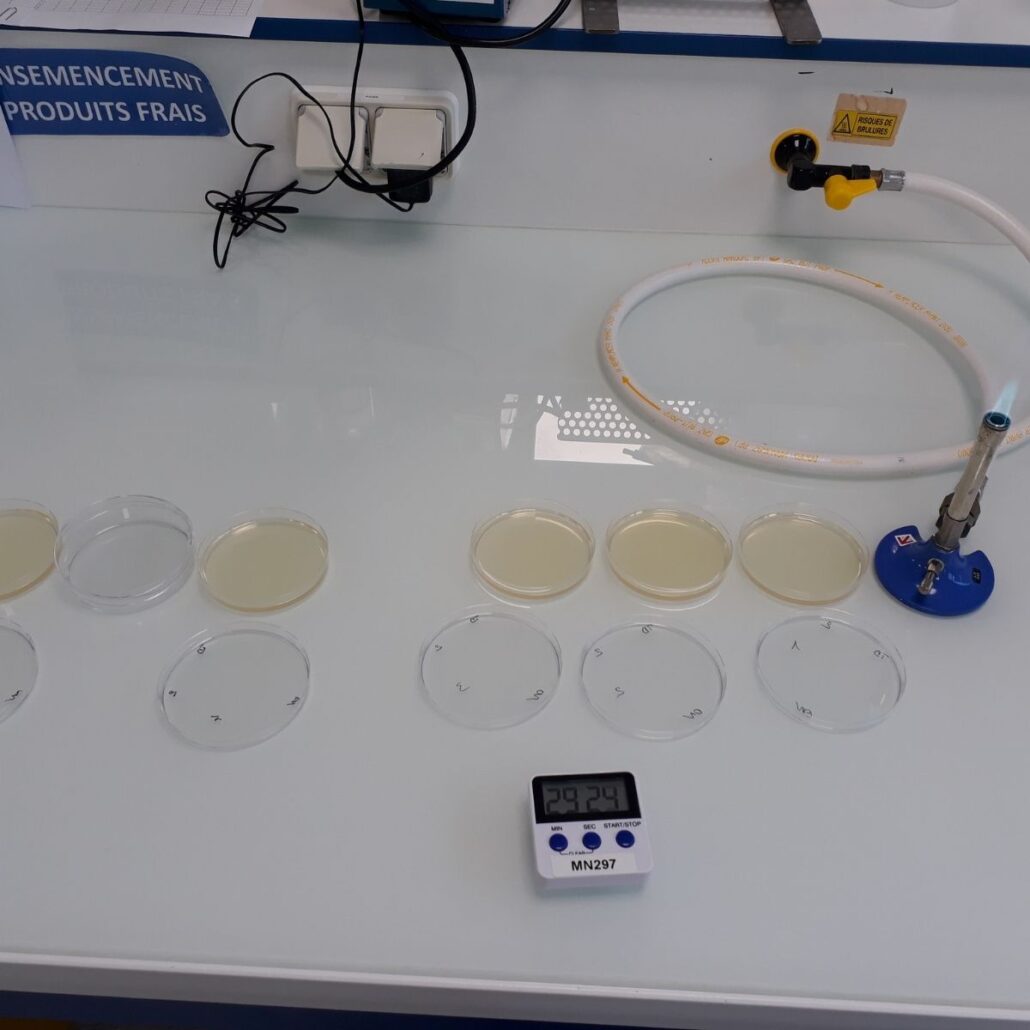
In each laboratory, a first set of 5 Petri dishes was left open for 30 minutes at different distances from a Bunsen burner that was switched off.
A second set of 5 dishes was then exposed under the same conditions, in the same place and on the same day, but this time with the burner on.
After incubation for 3 to 5 days at 30 °C, the colonies on each plate were counted.
How did we compare the results?
We treated each laboratory as a small independent experiment. At each distance, we compared only the two plates from the same laboratory. For example:
- Burner off: 12 colonies
- Burner on: 8 colonies
- → 4 fewer colonies with the burner on
We did exactly the same thing at each distance for all 126 laboratories, then combined the differences to see whether a clear trend appeared.
In other words: does the burner significantly reduce contamination, or do the results simply vary from one laboratory to another?
If you want to know exactly how the calculations were performed and which statistical tools were used, everything is detailed in the study available for download below.
Does the Bunsen burner really protect your work area?
So, here comes the big result… suspense… Well, no. Under the conditions of our experiment, we did not detect a significant protective effect from the Bunsen burner.
And this was true at every distance tested.
At some distances, the plates exposed with the burner on had slightly fewer colonies. At others, they had slightly more.
But in every case, the differences were very small: less than half a colony on average.
Most importantly, the statistical analysis could not distinguish these differences from the natural variability of the experiment.
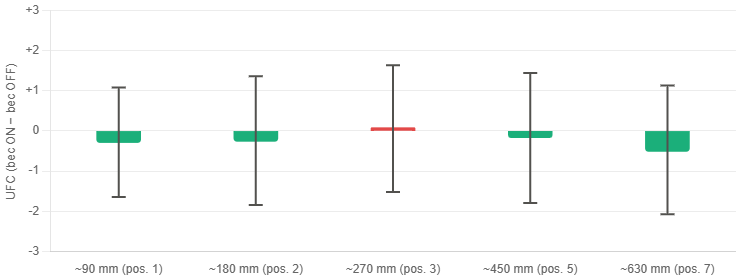
How should you read this graph?
A negative value means that, on average, there were fewer colonies when the burner was on.
A positive value means that there were more.
But what matters most are the uncertainty intervals: at every distance, they include zero. So we cannot conclude that having the burner on provides better protection than having it off.
Important: this does not mean the Bunsen burner is useless
Our experiment does not show that the Bunsen burner is useless in microbiology.
It simply shows that, under the conditions we tested, we did not observe a significant reduction in airborne contamination on exposed plates when the burner was on.
Our protocol also has several limitations… and these are explained in the study available for download below.
Gas or electric Bunsen burner: is there a difference?
Among the 126 participating laboratories:
- 109 used a gas burner;
- only 17 used an electric burner.
So we do not have enough data to properly compare the two technologies.
With only 17 laboratories using electric burners, any observed difference could easily be due to chance.
So this question remains open.
So, should we stop using Bunsen burners?
Our study does not support that conclusion.
It only looked at the passive deposition of airborne microorganisms onto open Petri dishes.
In particular, it did not test another major use of the Bunsen burner: flame sterilization of equipment.
Flame sterilization of an inoculating loop or wire between manipulations works through a completely different mechanism and is not called into question by our results.
So what should you do in your lab: Bunsen burner or no Bunsen burner?
To go further, the best approach would be for each laboratory to repeat the experiment under its own working conditions.
Using its own burner, environment, working practices and, most importantly, the distances at which technicians actually work every day (for example, when working close to a gravimetric diluter).
Rather than looking for a universal protective distance, each laboratory could answer a much more practical question:
under our usual working conditions, does turning on the Bunsen burner really reduce the risk of contamination?
If you repeat the experiment in your laboratory, feel free to share your results with us.
And if you agree, we could even turn your experience into an anonymous article so the whole SuperMicrobiologists community can benefit from it.