Key takeaways
- Some sample matrices can be extremely difficult to test for endotoxins because of interference and limitations on the maximum valid dilution (MVD).
- Sample preparation may require extraction, dilution, heat treatment or specific buffers, depending on the product being tested.
- According to Meg Provenzano, finding a suitable BET method often requires experimentation, even when testing products that appear similar.
This article is also available as a podcast in more than 20 languages. Click the ⚙️ Settings icon on YouTube, then choose Audio Track and Subtitles to watch it in your preferred language.
Some samples are easy to test for endotoxins. Others can become a real nightmare! 😱
You try different dilutions, adjust the sample preparation, change buffers… but interference is still there.
And when your endotoxin limit is very low, you may not have much room to dilute your sample further.
So what can you do when your Bacterial Endotoxin Test (BET) simply doesn’t work with your sample?
We asked Meg Provenzano, who has more than 15 years of experience in endotoxin testing, including hands-on laboratory testing, technical support and now product management.
She shared one of the most challenging samples she ever tested, and explained how she approaches difficult matrices in the laboratory.
What was the most difficult sample you ever had to test for endotoxins, and how did you manage to test it?
Meg Provenzano: Oh, this one brings me back!
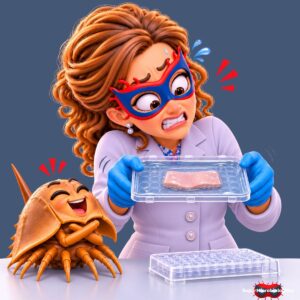
There was a surgical material, I think it was made from pig skin, but I’m not 100% sure. It was used for wound closures during surgery.
Obviously, it had to be endotoxin-free, but there was a lot of interference with this sample.
It also had a really low endotoxin limit, which meant we had to extract it in a very small volume of water.
I think it took two or three weeks, working with a few colleagues, to figure out how to test it while staying within the maximum valid dilution (MVD) and the endotoxin limit.
Eventually, we found a solution.
We used the lid of a 96-well microplate and placed the surgical material inside it.
Then we added LAL reagent water, let the material soak for an hour and collected the extract.
I think we also needed to use a dispersing agent and a glucan-blocking buffer.
But it took so many attempts to find a dilution that didn’t interfere with the assay!
Honestly, I felt like I was banging my head against the wall trying to make it work.
In the end, we figured it out and were able to give the customer both the results and the testing method.
It was a long process, and I think I still have a little PTSD from that one!
Is sample preparation one of the most difficult parts of endotoxin testing?
Absolutely!
There are many different ways to overcome interference, and the sample preparation really depends on what you’re testing.
For example, proteins usually need heat denaturation. Depending on the sample, you might need heat treatment at 60°C, 70°C or even 80°C.
But it’s not the same for every sample. You really have to figure out the right preparation for each individual product.
And even when products seem similar, that doesn’t mean they’ll behave the same way.
For example, if you’re manufacturing saline, you might make it differently from another manufacturer.
That’s why you need to look at the inhibition and enhancement profile of each sample.
Typically, I would start with tenfold dilutions, unless I already know the MVD or endotoxin limit.
Then I would see what works, try different buffers and look at the pH of the sample mixed with the LAL reagent.
There are different approaches, but you have to find what works for your particular sample.
“It’s not the same for every sample. So you really have to figure out the sample preparation for each individual sample.”
So finding the right BET method is also a matter of experience?
Exactly! And experimentation, honestly.
Sometimes you just have to try different things and figure out what works best.
USP chapter <1085> also provides some useful advice on different materials.
But in the end, you really have to experiment and find what works for your situation, in your own laboratory.
A big thank you to Meg Provenzano for sharing this experience! It’s reassuring to know that even after 15 years of endotoxin testing, some samples can still give you a serious headache! 😅
If you have any questions about endotoxins, feel free to ask them in the comments.