Key points
- Sampling after cleaning and sampling during production do not answer the same questions.
- Sampling a machine while it is stopped just after cleaning may give an incomplete picture of the situation.
- Running the equipment for a few minutes before sampling can help release hidden contamination.
This article is also available as a podcast in more than 20 languages. Click the ⚙️ Settings icon on YouTube, then choose Audio Track and Subtitles to watch it in your preferred language.
The production area has just been cleaned.
The visible surfaces are clean and the equipment is stopped. You take a sample… and nothing: no Listeria is detected.
But a few hours later, during production, the bacteria appear again in the samples.
Was the cleaning not effective enough? Or was the sample simply taken at the wrong time?
We asked Benjamin Yger when sampling should be performed to obtain really useful information.
Should sampling be performed after cleaning or during production?
Benjamin Yger: Sampling should be performed in both situations because the information obtained is different.
After cleaning, I want to know whether the cleaning was effective enough and whether the equipment can restart in good conditions.
During production, I want to know whether contamination appears or moves through the production area during the day.
It may be linked to an incoming flow, a raw material, an operator’s movements or something that only happens when the production line is running.
So these two sampling times are complementary.
Why can sampling immediately after cleaning be misleading?
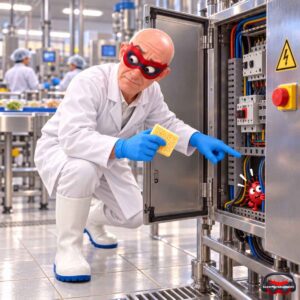
When the machine is stopped, the surfaces that are sampled are usually the most visible and the easiest to clean.
If Listeria is hidden in a corner or in an area that is difficult to reach, it may not be present on the sampled surface at that moment.
You can therefore get a negative result even though contamination is still present inside the equipment.
This is why, when possible, I recommend running the machines and conveyors before sampling.
What can restarting the machine reveal?
Movement can release contamination that was hidden in an area that is difficult to access.
If contamination is present in a hidden part of the machine, it may return to a surface that can be sampled when the conveyors and other moving parts start running again.
This does not mean restarting the whole production process.
The equipment can simply run for five, ten or fifteen minutes, depending on the production line. The aim is only to create enough movement to see whether anything is released.
If the sample becomes positive after restarting the equipment, how should this be interpreted?
You should not automatically conclude that the cleaning team did a poor job.
The cleaning procedure may not have been applied correctly. In that case, the practices need to be brought back to the expected level.
But if the procedure was correctly followed, the result may show that contamination is located in an area that normal cleaning cannot reach.
It may be a part of the machine that traps material, a damaged seal, a worn component or an area that is difficult to access.
The root cause investigation then needs to go further and, if necessary, part of the equipment may need to be dismantled to understand what is happening inside.
What can samples taken during production tell us?
They show what happens when the production area is actually operating.
A production line may be clean at start-up and then become contaminated during the day.
If samples become positive during production, you need to ask whether a flow is bringing Listeria into the production area or whether a specific event is helping it spread.
The timing of sampling should therefore always be chosen according to the question you want to answer.
Thank you to Benjamin for sharing his experience.
If you have any questions, feel free to ask them in the comments… together with the other SuperMicrobiologists, we’ll do our best to answer them.
About Benjamin Yger
Benjamin Yger is an engineer specializing in microbiology and food safety, with around 20 years of experience in the food industry, particularly in fresh and ultra-fresh food production.
Through his company QUALSECAL, he now supports food manufacturers and equipment suppliers with food safety, quality systems and hygienic design. He provides consulting, auditing and training services.