In food microbiology, PCR has become an essential tool for the rapid detection of pathogens such as Salmonella and Listeria.
But behind this performance lies a risk that microbiologists know all too well: cross-contamination by amplicons.
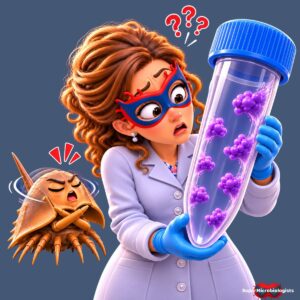
With amplicons, just a few copies of DNA can sometimes be enough to generate false-positive PCR results.
A microbiologist recently told us that a single poorly closed PCR tube thrown into the waste had led to 4 weeks of laboratory shutdown.
We interviewed a microbiologist working in a food industry laboratory who uses PCR on a daily basis.
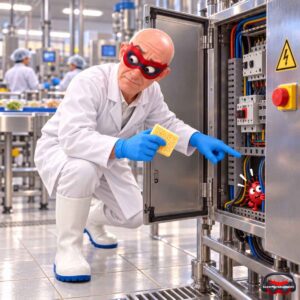
He explained how he manages this risk… and, most importantly, how he effectively cleans his PCR area.
The real problem in PCR: amplicons
Unlike traditional microbiological testing, PCR does not only detect living microorganisms.
After a positive PCR run, billions of copies of target DNA (amplicons) can be generated. These DNA fragments are extremely volatile and can contaminate the laboratory environment.
The result: false positive PCR results that are not confirmed on agar plates.
This is precisely why the segregation of PCR areas is considered essential in many laboratories.
The most commonly recommended organization relies on at least 3 separate areas:
- one room dedicated to lysis and sample preparation,
- a second room for PCR mix preparation,
- a third room dedicated to amplification and thermocyclers.
Ideally, this setup should also include a unidirectional workflow, lab coat changes between areas, and controlled airflow management.
Why cleaning a PCR lab is different
Cleaning a PCR area does not follow the same rules as standard microbiology cleaning.
For microorganisms, detergents and disinfectants are usually enough. But for amplicons, this is not sufficient. A DNA-denaturing product must also be used to degrade the DNA.
In his laboratory, our SuperMicrobiologist uses a DNA-denaturing solution. PCR areas (benches, small equipment, etc.) are sprayed daily, while respecting the required contact time.
Some blocks or small equipment can also be soaked in diluted bleach, which is known for its DNA-denaturing effect.
Sodium hypochlorite (10–11 %), also known as bleach, remains one of the reference solutions for destroying DNA strands, provided that a sufficient contact time (10–15 min) is respected.
Be careful though: bleach can be corrosive… it may rust steel and stainless steel surfaces. Rinsing with clean water is therefore essential.
When cleaning a PCR laboratory, some areas are often forgotten even though they can become real reservoirs for amplicons, especially:
- centrifuge rotors and the inside of centrifuges,
- pipette holders,
- handles,
- PCR tube opening areas.
How to check that no amplicons remain
After a contamination event, cleaning with a DNA-denaturing product must be extensive and rigorous: benches, equipment, instruments, walls, floors, and more.
But cleaning is not enough. Before restarting analyses, the laboratory must confirm that no amplicons remain in the PCR area.
Several checks can be performed:
- Air monitoring: DNAse-free water tubes are left open, then analyzed by PCR
- Surface monitoring: swabs or wipes are analyzed by PCR
During the following PCR runs, negative controls must remain negative, and any positive result should be confirmed on agar plates
Conclusion
In a PCR laboratory, the real enemy is not only cross-contamination by living microorganisms… but also their DNA.
Effective cleaning therefore relies on:
- Environmental and PCR controls to validate cleaning efficiency for both microorganisms and amplicons
- Standard cleaning and disinfection for living microorganisms
- DNA-denaturing products to eliminate amplicons