Buying a new laboratory blender isn’t normally something that puts a microbiology lab at risk, either financially or in terms of its overall organization. But choosing the wrong blender could prove very… annoying for the smooth running of your lab.
In this article, we’ll go through all the criteria to consider before buying a new laboratory blender.
Table of contents:
- What is a laboratory blender-homogenizer used for?
- Technical specifications
- Practical features
- After-sales service
- Trust in your supplier
What is a laboratory blender-homogenizer used for?
If you’re reading this article, you probably already know what a microbiology laboratory blender is used for… But in a few words, a blender is an instrument used to homogenize a sample matrix (usually food) in a diluent to extract microorganisms (bacteria, yeasts and molds).
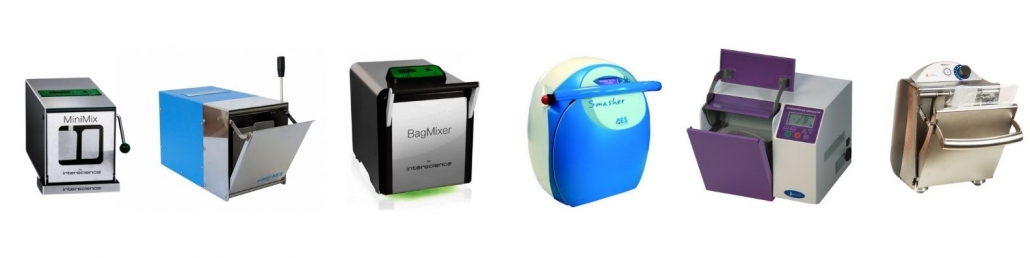
We’re using the term “blender-homogenizer” here, but when we ask microbiologists on LinkedIn, we realize that they use all sorts of names for this… instrument:
Microbiologists very often use the term stomacher (which actually comes from Stomacher®, the brand name of the first laboratory blenders).
Other names include paddle blender, peristaltic-type blender using sterile bags (as described in ISO 7218), and paddle homogenizer.
There’s no right or wrong terminology, but to avoid upsetting anyone, we’ll use all these terms throughout the article.
Technical specifications of a laboratory blender-homogenizer
Blending time settings
This parameter shouldn’t (normally) be a problem, but it’s still worth checking that all the blending times you need are available.
Blending power settings
Depending on your sample matrices, you may need several blending power settings. Manufacturers generally offer two or three. Power can be selected through a program or by adjusting the paddles (or both). The best approach is to test the blender in your laboratory with your own sample matrices.
Compatibility with all blending bag sizes
Make sure the blender can handle all the sample volumes and bag sizes you use.
Standard 400ml bags shouldn’t be a problem, but what about smaller 80ml bags (for wipes or sponges)? Can the paddles be adjusted easily to ensure proper homogenization? And don’t forget that some laboratories blend two bags at the same time.
For very large volumes, you’ll often need to move to a larger blender.
Compatibility with filter bags
When bags contain a filter (side filter or full-page filter), the liquid may rise above the point where the blender door closes. But is that really a problem? It’s up to you to test it and decide.
Practical features of a paddle blender
Ease of use
There are two essential points to check:
- Is the bag easy to position? With some blenders, the bag must be placed neither too high nor too low. A small positioning stop can make handling easier.
- Does the door open and close easily? This movement may be repeated hundreds of times a day, so it needs to be smooth, intuitive and effortless.
Both points should be tested by the users. Even a seemingly minor change, such as replacing a blender, is never straightforward. It needs to be supported, explained and validated by the users.
Noise level
The latest generation of paddle homogenizers is now much quieter than previous models. This is important because when processing dozens or even hundreds of samples per day, noise can become a real problem in the laboratory.
However, not all quiet blenders are equally quiet. The best approach is to test the blender in your laboratory with your own sample matrices. And always perform the test with a sample inside the blender!
Ease of cleaning
We don’t want to jinx you, but sooner or later, a bag will burst… and probably more than one!
That’s why it’s important to assess how easy it is to clean the inside of the blending chamber. It can quickly become a breeding ground for microorganisms that could come into contact with your samples.
Are there any hard-to-reach corners? Can you access them easily? Are the paddles removable? Is there a collection tray, and is it easy to handle? All these points should be checked during the trial period.
Blender size (even if size isn’t everything… right?!)
If you’re short on workbench space, this can be an important criterion. The size differences between the models available today can be… huge!
Blender weight
Sure, we don’t move our blenders every day, but we still need to clean the workbench underneath them regularly. That’s why weight remains an important consideration… although it does mean you get a free workout!
Blender vibrations
When your blender is running, the workbench may vibrate. This could affect other instruments placed on the same workbench (your diluter, perhaps?).
That’s why you should test the blender exactly where it will be installed.
After-sales service for your stomacher
Replacement of wear parts
Does the blender have parts that wear out, such as:
- Door seals
- Paddle clips
- Other parts
If so, how often do they need replacing? Can your laboratory replace them, or does the manufacturer need to send a technician? Don’t hesitate to ask about the prices before buying the blender.
What happens if the blender breaks down?
A broken blender can bring a laboratory to a standstill.
So what does the manufacturer offer in this situation?
- On-site technical support? If so, how quickly can someone come?
- Can a replacement blender be sent within 1 or 2 days while yours is being repaired?
Trust in your supplier!
There’s one final criterion, and it’s the same for every technology: the trust you have in your supplier!
This may seem subjective, but it’s important and can be based on tangible criteria, such as:
- Are they easy to reach by phone? Do you speak directly to someone or end up dealing with an automated phone system?
- Have you worked with them before? If not, ask another laboratory for feedback (on LinkedIn or through SuperMicrobiologistes).
- Are they responsive and quick to provide solutions when problems arise?
You now have everything you need to choose the perfect blender for your laboratory. Now it’s your turn!
Don’t miss our next article! Subscribe to our newsletter here!