
When microbiologists are asked what the most annoying task is, almost everyone answers: “Serial dilutions.”
On one hand, it’s repetitive and hard on the joints (risk of MSDs).
On the other hand, it requires a lot of focus and precision. Lose track (or the tube), and you might end up with inaccurate results.
Not easy… here’s the proof:

During our visits to microbiology labs, we’ve come across methods that help standardize, simplify, or even eliminate serial dilutions altogether.
We invite you to explore them in this article.
Content :
- Fully automated solutions
- Semi automated solutions
- Other manual solutions
What is a serial dilution?
In microbiology, it’s important to know that colonies on a Petri dish can’t be counted if there are too many. Generally, the limit is set at 250–300 colonies maximum.

Photo credit : STL biotechnologies St Germain en Laye
When a product contains a lot of microorganisms, serial dilutions are necessary to count them accurately. For this, glass tubes are often used.

Typically, dilutions are made by adding 1 ml of the sample to 9 ml of diluent (a 1/10 dilution) or 0.1 ml to 9.9 ml (a 1/100 dilution).
From each tube, a sample is then taken and plated onto a Petri dish, either by pour plating (1 ml) or surface plating (0.1 ml).
For each dilution, the steps are as follows:
- Open tube A.
- Take 1 ml of the sample.
- Close tube A.
- Open tube B (while holding the pipette).
- Transfer the liquid from tube A into tube B.
- Close tube B.
- Vortex tube B for 10–15 seconds—the longer, the better!
- Open tube B, take 1 ml, and repeat the process for tube C, and so on.

Serial dilutions: What’s the problem?
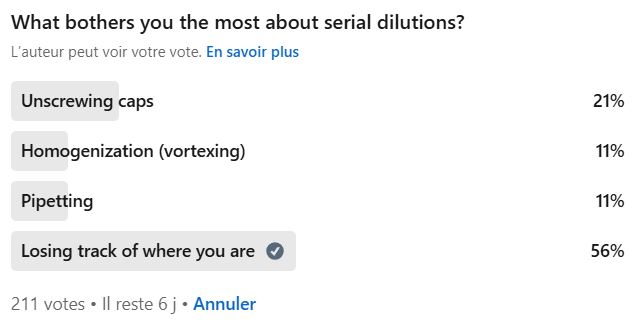
Here are the main issues we’ve identified (with the help of the SuperMicrobiologists):
- Poor homogenization
Tubes must be properly mixed using a vortex to ensure microorganisms are evenly distributed.
The problem? There are as many ways to use a vortex as there are microbiologists. (According to ISO 6887-1, the recommended mixing time is 5 to 10 seconds). - Pipetting precision
Precision is essential when sampling 1 mL or 0.1 mL to avoid dilution errors. - Tube confusion / Loosing track of where you are
It’s important not to confuse the tubes when sampling and dispensing.
The challenge? Staying focused on a repetitive task is not as easy as it sounds. - Unscrewing caps
Using glass tubes means opening and closing hundreds of caps every day.
The result? Repetitive movements increase the risk of MSDs (Musculoskeletal Disorders).
Let’s now look at some practical solutions to make serial dilutions a bit more… manageable.
Fully automated solutions
Automated Bioburden Testing system by Merck
This solution fully automates serial dilutions … but it does much more than that. Basically, you give it your liquid sample, and it delivers a Petri dish ready for incubation.
Following the same method as manual testing with the already known Milliflex OasisⓇ filtration devices, this system allows you to transfer a large volume of samples to a fully automated workflow. Designed to manage dilution preparation prior to filtration and then pipetting, pre-wetting and rinsing steps, the system allows a wide typology of protocols.
Achieving the same quality of work as your best lab technician, who will then be able to focus on higher value activities, this system applies good microbiology practices. It masters repeatable optimal membrane transfer (visual check performed and 0 issue due to incorrect transfer) and reduces the risk of cross contamination to offer you the maximum reliability of results.
Automation also integrates complete traceability to prove compliant testing has been performed and to ease any investigation needs.
Domains of use :
Bioburden testing and water testing in pharma and biotech industries.
Analytical performance:
- Up to 160 filtrations per 8h shift or 480 filtrations per day of 3 shifts.
- Free up to 6 FTE (Full Time Equivalent) per year for more added value tasks.
- On average the return on investment is 3 years.
Automated Bioburden Testing system key strengths
- Results reliability
- Full traceability
- Walk away solution
Cyclone™ from Copan

Cyclone™ is a fully automated system for microbiological quality control dedicated to the industry sector.
This robotic system helps laboratories in many steps of daily lab routine, from serial dilutions to pour plating single and double layer, spreading, streaking and spiral plating.
Cyclone™ can manage different protocols in the same run using various shaped containers, different inoculation volumes, sample mixing, dilution set, and multi-agar types.
Thanks to communication with any LIMS system, Cyclone enables automatic sample ID tracking, protocol parameter definition, and the generation of a final feedback report to the LIMS for all prepared plates.
Its high scalability allows laboratory performance to be adjusted according to operational needs, even during high production peaks, while enabling the reallocation of laboratory staff to higher value-added activities.
The Cyclone, equipped with an H14 HEPA filter, does not need to be installed in classified areas.
Domains of use :
Food, Cosmetics, Ingredients, Baby food, Service Labs
Analytical performance:
More than 100 plates/hour based on the specific customer techniques mix.
Cyclone key strengths
- Full automatized horizontal method with full traceability
- Extreme Flexibility and Operative Costs Reduction
- Enhanced Quality & Repeatability
The Spiral Plater by Interscience

The spiral plater is an automatic plating technique that allows the equivalent of 4 logs (3 dilutions) to be spread on a single Petri dish.
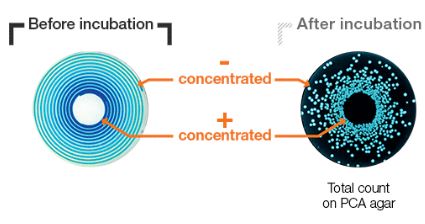
All spiral platers use the same technique. A drop of the “mother” solution is deposited in the center of the Petri dish, then spread across the entire surface. This process dilutes the solution through exhaustion.
The plating follows a logarithm decreasing curve from the center of the dish to its edges. As the solution is spread, it becomes progressively more diluted.
It’s a bit like dipping your finger in a drop of coffee and dragging it across a surface to create a line. The end of the line is less colored than the beginning.
And how about reading the results? Counting can be done manually (well, with your eyes), but it’s much easier and faster with an automatic colony counter.
Key advantages of Interscience’s spiral plater:
- Fewer dilutions: With just one Petri dish, you can cover 3 dilutions, providing a counting range from 100 to 1 x 10⁷ CFU/mL.
- Fully automated device: This means fewer risks of errors.
- Standardized spreading: (check out this article about the “deadly impact” of spreading with a hockey stick!).

Cherry on the cake: The easySpiral Dilute version allows for the automation of 5 serial dilutions (1/10) before proceeding with spiral plating. It can handle up to 10¹² CFU/mL.
Semi automated solutions
The Serial Diluter UC: Inlabtec’s Serial Dilution System
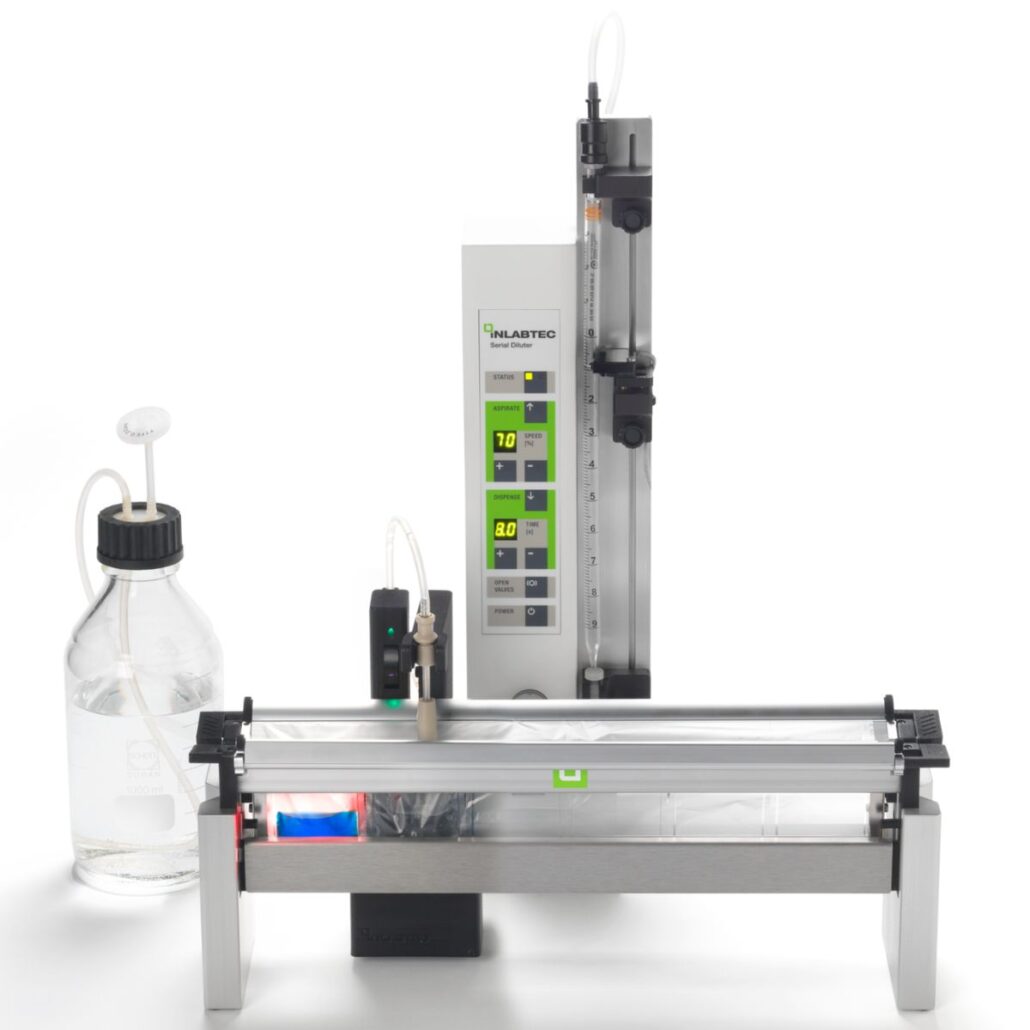
The Inlabtec Serial Diluter UC automates routine serial dilutions to improve accuracy, speed, and workflow efficiency in microbiological labs.
Using disposable dilution bags and standard 10 ml pipettes, it performs mixing and dilution automatically after each inoculation step. LED guidance ensures intuitive operation, while the closed-bag system reduces contamination risk and plastic waste.
With up to six dilution steps per run, the Serial Diluter UC delivers repeatable, high-precision results and significantly reduces manual handling
Domains of use:
Microbiology testing for food, feed, water and beverage safety and quality.
Analytical performance :
A full six-fold serial dilution can be completed in about one minute
Key advantages of the Inlabtec Serial Diluter:
- Automation for Accuracy & Consistency: No need for a vortex! The Serial Diluter guarantees perfectly mixed, reproducible dilutions every time.
- Intuitive Workflow: A light clearly indicates which bag to use next, guiding the operator step by step, ensuring accuracy with minimal effort.
- Sustainability & Cost Efficiency: Lightweight, thin-walled bags significantly reduce material usage, waste, and the ecological footprint compared to traditional methods.
The Dilucup® System by LabRobot

The Dilucup® System is an innovative solution that replaces dilution tubes and vortex mixers. It consists of Dilucup® Elegance, which are ready-to-use dilution cups usually filled with 9mL of sterile diluent and the Dilugent® Shaker.
During dilution, the shaker uses a color-coded LED to indicate which cup to draw liquid from and which cup to transfer it to… greatly reducing the risk of errors.
Between dilutions, a simple hand wave in front of a sensor activates the vortex, ensuring automatic and standardized homogenization.
Domains of use:
Food microbiology, Bio Industry, probiotic strain enumeration, paper industry, cosmetics, process water. Useful in any laboratory that routinely performs decimal dilutions
Analytical performance:
Save 50% of the time per dilution compared to dilution tubes and the vortex mixer.
Key advantages of the Dilucup system:
- Automatic, standardized: The vortex integrated into the platform homogenizes the Dilucups automatically between each transfer… with always the same time and speed for each sample.
- Time Saving: It saves half the time compared to dilution tubes and vortex per dilution, plus all the tube preparation, calibration, washing, etc.
- Tracability: Dilugent Shaker allows to trace dilutions.Why is it useful to trace dilutions? Tracing dilutions it is interesting for instance to investigate whether there was an error in execution that could explain an unexpected enumeration of microorganisms.
Other solutions
Easy-open tubes
This solution may not completely revolutionize serial dilution… or maybe it will!
As we mentioned in the section “Serial dilutions: What’s the problem?”, a big part of the process involves opening and closing tube caps.
The main issues with classic tubes:
- They are often very hard to open.
- You have to turn them several times to open and close them.
- When you repeat this process hundreds of times a day, it creates the perfect conditions for developing musculoskeletal disorders (MSDs).
The solution? Use tubes with an easier opening system or at least an opening system that requires less effort.
More and more manufacturers are offering this type of tube, either with plastic caps (easier to unscrew) or with shorter screw threads.
This solution won’t eliminate all the challenges of serial dilution, but it does offer greater comfort at a lower cost.
Be careful! Make sure your new tubes don’t leak, as this is a potential risk with certain designs.
We hope this article helps you find the best solution for your lab to make the serial dilution process easier.
If you know of other ways to simplify serial dilutions, feel free to share them with us in the comments!



One Response