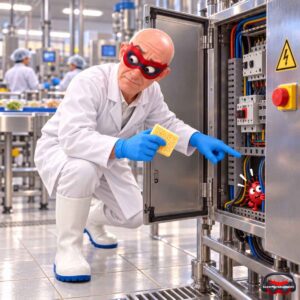
On this blog, we often talk about microbiological quality control in the food, cosmetic, or pharmaceutical industries…
But there are also other, lesser-known sectors where bacteria are “hunted.”
During a trade show, we came across a rather unusual quality control laboratory that performs microbiological testing in microelectronics!
As if electronic chips could also have… bugs.
Of course, our curiosity took over.
So we got in touch with Valérie Delbart and Julie Di Gennaro to learn more about these very specific analyses.
Microelectronics and microbiological risks
Can you introduce the activities of your microbiology laboratory?
The microbiology unit of the Measurements and Controls Division at Egis Industrie et Process provides microbiological testing services for air, surfaces, and water. We work in several sectors, including pharmaceuticals, cosmetics, and microelectronics. Our laboratory is COFRAC accredited (COFRAC accreditation No. 1-6388).
“Some microorganisms (…) may cause short circuits on electronic chips and make them unusable.“
What exactly is microelectronics?
Microelectronics is a field of electronics focused on the design and manufacturing of extremely small components, called integrated circuits or electronic chips. These chips are found in many everyday objects: phones, computers, cars, medical devices, and connected objects.
Microelectronics mainly relies on semiconductors, especially silicon, and on very precise manufacturing processes carried out in cleanrooms.
Why look for microbiological contamination on semiconductors?
Even very small microbiological contamination can affect how components work. Some microorganisms can create conductive deposits. These deposits may cause short circuits on electronic chips and make them unusable.
“We analyze water that is or will be in contact with silicon wafers.”
Water testing and rapid microbiological methods
How do you test for bacteria on electronic chips?
In microelectronics, ultra-pure water is used to clean surfaces and equipment and is also essential during the manufacturing of silicon wafers. Monitoring these ultra-pure water loops is critical. The quality of the water must be extremely high to ensure the reliability of integrated circuits.
That’s why continuous monitoring and fast reaction in case of contamination are essential to limit production losses.
So in practice, you analyze water?
Yes, exactly. We analyze water that is or will be in contact with silicon wafers.
How do you analyze this water in your laboratory?
We use an internal protocol to characterize the type of water before choosing the most appropriate measurement method.
Analyses are performed using solid-phase cytometry, which allows us to obtain results in less than 4 hours.
“Rapid methods can detect more than 50% of microorganisms (…). In contrast (…) it is estimated that only about 3% of microorganisms grow on agar.”
Which microorganisms do you look for?
It depends on the client’s needs. We can measure the total microbial flora or focus specifically on molds.
Are there microorganisms that are “pathogenic” for microelectronics?
Yes. For example, Thiobacillus ferrooxidans is not pathogenic to humans, but it can damage electronic components.
What are the benefits of rapid microbiological methods for your clients?
Rapid methods, such as solid-phase cytometry, are a strong alternative to traditional culture methods.
They allow efficient microbiological monitoring of water systems in microelectronics.
Fast detection (in less than 4 hours) of viable cells (including non-cultivable ones, greatly improves reaction time in case of contamination. This also allows better control of manufacturing processes.
These methods are often preferred to traditional ones, especially to check the effectiveness of targeted cleaning before safely restarting water systems.
“We are also active in the space industry. The goal there is to ensure the absence of contamination in water networks used during the manufacturing of optical components.“
Do rapid methods detect as many microorganisms as traditional methods?
They actually detect even more.
Rapid methods can detect more than 50% of microorganisms, including viable but non-cultivable ones.
In contrast, traditional culture-based methods using R2A agar only detect microorganisms that are able to grow on this medium.
Today, it is estimated that only about 3% of microorganisms grow on agar, which leads to a significant underestimation of water contamination.
In which other “atypical” fields do you perform microbiological testing?
Thanks to the advantages of solid-phase cytometry, we also work in other sectors beyond microelectronics, such as cosmetics and medical devices.
We are also active in the space industry. The goal there is to ensure the absence of contamination in water networks used during the manufacturing of optical components.
A big thank you to Valérie and Julie for welcoming us into their microbiology laboratory and for sharing insights into these unusual (but extremely important) microbiological analyses!
If you also work in a laboratory that performs microbiological analyses outside the usual fields, feel free to contact us. We would be delighted to highlight the incredible diversity of jobs and applications in microbiology.