We won’t lie, starting this article on endotoxins wasn’t easy!
Endotoxins are at the crossroads of chemistry, biochemistry, and microbiology… not the most relaxing topic.
But since most endotoxin tests are done in microbiology labs (and we’ve made peace with our chemistry teachers), we decided to dive in anyway, and guess what? We actually loved what we found!
Here’s a simple summary of what endotoxins are and why they’re a real problem in pharmaceutical microbiology labs.
What is abacterial endotoxin?
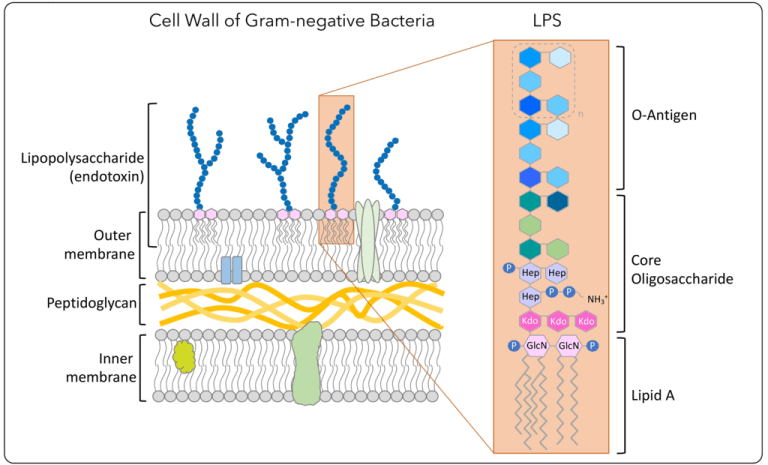
Endotoxins are bacterial pyrogens, substances that can cause fever.
They are lipopolysaccharide (LPS) molecules found on the surface of Gram-negative bacteria.
When these bacteria are destroyed (for example, by heat), they release their endotoxins into the product.
If that product is injected (like a vaccine), the endotoxins can trigger an immune response, including fever, and in some cases, even death.
So yes, endotoxins are no joke.
In which products do we test for endotoxins?
Endotoxins can be found in any product that has ever had bacterial (bioburden) contamination, which is… a lot of products!
The highest-risk products are:
- Injectable medicines
- Medical devices used for injections
But we don’t just check the finished product, we also test raw materials (like water for injection – WFI), and even steam used to disinfect equipment.
Why? Because once endotoxins are there, they’re very hard to remove.
Why are endotoxins a big problem in pharma?
Unlike bacteria, you can’t filter out endotoxins easily.
You can’t just sterilize them away, because when bacteria die, that’s when endotoxins are released!
And it gets worse:
We microbiologists can’t see them grow on petri dishes. Traditional microbiology methods don’t work here.
Instead, we need to use chemical or biochemical tests (yes, we know… it hurts a little to admit it 😅).
Good news: we’ve written a full article listing all the available methods for detecting bacterial endotoxins.
What are the allowed endotoxin limits?
Les limites réglementaires d’endotoxines bactériennes dans les produits pharmaceutiques sont strictement encadrées par les The regulatory limits for bacterial endotoxins in pharmaceutical products are strictly defined by pharmacopoeias (Ph. Eur., USP, JP), and mainly depend on three factors:
- The route of administration
- The maximum dose given to a patient per hour
- The type of product (e.g., medical devices, injectable drugs, etc.)
And to calculate the limit… yes, there’s a math formula (we told you endotoxins aren’t just about microbiology!).
L= K / M
L = Endotoxin limit
K = Maximum allowable endotoxin dose (in EU/kg/h)
M = Maximum product dose given per kg of body weight per hour
We warned you, this part wasn’t going to be fun!
Here’s a concrete example to (hopefully) make it easier to understand:
For an intravenous product given at 100 mg/h to a patient weighing 70 kg:
- K = 5 EU/kg/h
- M = 100 mg / 70 kg = 1.43 mg/kg/h
- L = 5 / 1.43 ≈ 3.5 EU/mg
So, the product must not contain more than 3.5 EU per mg of active substance.
The K values can be found in the pharmacopoeias. Here’s an example for two types of products:
| Administration | Standard regulatory limit (K) |
| Intravenous (IV) | 5 EU/kg/h |
| Intrathecal (epidural, spinal) | 0,2 EU/kg/h |
EU = Endotoxin Unit
As you can see, a small amount of endotoxins is allowed in products. At these levels, there is no risk for patients.
That’s why we talk about endotoxin levels, the quantity really matters.
Conclusion
As you’ve probably understood by now, endotoxins are serious troublemakers in the pharmaceutical industry.
They’re invisible, tough to destroy, and can’t be detected using traditional microbiology methods — which means we need to stay alert at every step of the production process.
Since removing them is not easy, detecting them becomes a top priority to ensure patient safety.
In an upcoming article, we’ll explain exactly which methods are used to detect bacterial endotoxins.
Spoiler alert: it involves chemistry and biochemistry… but don’t worry, it’s actually pretty fascinating!