Key takeaways
- For Listeria monitoring, Philippe Armaing recommends splitting environmental sampling into three periods: one third after cleaning under dynamic conditions, one third during production and one third at the end of production.
- After cleaning, he recommends running the equipment empty for at least 10 to 15 minutes before sampling, to check for any release of contamination during restart.
- Sampling at different times also means training production and cleaning teams, because the quality team cannot always be available at 3 or 4 a.m. as well as at 9 p.m.
This article is also available as a podcast in more than 20 languages. Click the ⚙️ Settings icon on YouTube, then choose Audio Track and Subtitles to watch it in your preferred language.
When should you look for Listeria in the environment of a food factory?
After cleaning? During production? At the end of the day?
According to Philippe Armaing, you should not choose just one of these moments.
He still regularly sees manufacturers testing for Listeria only after cleaning. And when those checks are also performed under static conditions, with the equipment stopped, they may miss contamination that only appears once the line is running.
His recommendation is therefore simple: vary the sampling times.
Why not look for Listeria only just after cleaning?
When should environmental sampling be performed: after cleaning, during production or before cleaning?
Philippe Armaing: You need to mix the sampling times.
I quite often see manufacturers who, unfortunately, only monitor after cleaning.
And when they monitor after cleaning under static conditions, meaning with the equipment stopped, they are unlikely to find much.
Yet they may have Listeria present during production and one day detect it on the product. And by then, as we said, it is too late.
The objective is therefore to vary the sampling times.
What distribution do you recommend in practice?
I recommend a one-third, one-third, one-third approach.
One third after cleaning, but under dynamic conditions. Another third during production. And the final third at the end of production.
This gives you three different sampling periods within the Pathogen Environmental Monitoring (PEM) program.
After cleaning, run the line before sampling
What do you mean by post-cleaning sampling “under dynamic conditions”?
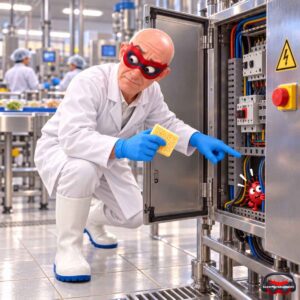
It means running the equipment empty.
A mixer, grinder or conveyor, for example, should run empty for at least 10 to 15 minutes.
The objective is to check not only that the equipment has been properly cleaned, but also that operating it does not release contamination.
Contamination can be released from the shafts of mixer blades, grinder shafts or conveyor shafts during the restart phase.
That is what needs to be checked.
Post-cleaning monitoring should verify that the equipment does not release contamination when it is put back into operation.
This is why I recommend post-cleaning sampling under dynamic conditions, after the equipment has been running empty.
Why sample during production and at the end of production as well?
What is the value of sampling at the end of production?
The advantage is that if I take samples from food-contact or nearby surfaces at the end of production and find nothing in the environment, that information is still relevant to the hygienic conditions in which the products were manufactured during the day.
It obviously does not give me the result of the finished product itself, but it does provide information about the environment in which the day’s products were manufactured.
That is why I recommend combining the three sampling periods: after cleaning under dynamic conditions, during production and at the end of production.
Train teams so sampling can be performed at the right times
Isn’t this distribution difficult for the quality team to manage?
Yes, it can be quite difficult.
Samples may need to be taken at 3 or 4 a.m., during the day or even at 9 p.m.
And quite often, it is the quality team that performs the environmental sampling.
So I recommend training cleaning operators and production operators as well.
Taking a sample with a sampling cloth or sponge is not particularly complicated once people have been properly trained.
This makes it possible to perform specific, well-targeted environmental sampling at times when the quality team cannot easily be present.
It also helps involve everyone. Listeria control is not solely the responsibility of the quality team.
Maintenance, production and cleaning teams also have a role to play.
Many thanks to Philippe for sharing his experience and these practical recommendations on choosing the right time for environmental sampling.
If you have a question, feel free to ask. We will do our best to answer it.