Key points
- Environmental sampling does not necessarily need to be performed by laboratory technicians.
- Production, cleaning or quality teams can perform sampling, as long as they are properly trained.
- A culture focused on finding causes rather than blaming people helps make sampling more reliable and encourages greater team involvement.
This article is also available as a podcast in more than 20 languages. Click the ⚙️ Settings icon on YouTube, then choose Audio Track and Subtitles to watch it in your preferred language.
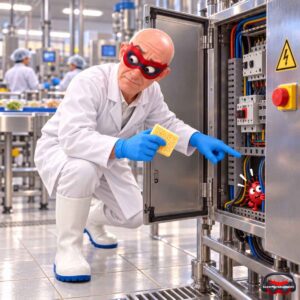
Environmental sampling may look like a simple task.
But you still need to avoid contaminating the sample, swab the surface properly and choose the right location.
The person taking the sample must also be there at the right time and be able to react when they notice something unusual in the production area.
So, should this task be handled by the laboratory, quality, production or cleaning teams?
We asked Benjamin Yger.
Should laboratory technicians perform all environmental sampling?
Benjamin Yger: Not necessarily.
When a factory has an internal laboratory, I consider the technicians’ time to be particularly valuable.
Their role is to perform analyses, produce reliable results and be able to handle a large number of analyses when a problem occurs.
If technicians are systematically asked to leave the lab and take samples in the production area, this reduces that capacity.
Sampling can therefore be performed by production, cleaning or quality teams.
What matters most is not the person’s job title, but their training and their ability to take the sample correctly.
What does someone need to know to take a good sample?
First, they need to know the procedure and be properly trained so they do not contaminate the sample themselves.
But they also need to know how to sample effectively.
Quickly wiping a surface is not enough. The sampling method needs to have a real chance of recovering Listeria if it is present.
So the person needs to understand both how to perform the sampling and why it is being done.
Is there an advantage to asking production teams to perform sampling?
Yes. It helps involve the teams and give them more responsibility.
Production is not only about producing. Production teams also contribute to controlling Listeria and keeping products safe.
Operators are in the production area every day. They know the equipment, the usual practices and unusual situations.
When they understand the purpose of sampling, they become additional people who can help monitor risks.
Can cleaning teams sample areas they have just cleaned themselves?
This can raise questions about a possible conflict of interest, but it really depends on the company culture.
If every positive result immediately leads to blaming the cleaning team, people may feel judged or try to protect themselves.
But finding Listeria does not necessarily mean that the cleaning procedure was poorly performed.
The problem may come from damaged equipment, an inaccessible contamination source or a machine that is difficult to clean.
If this complexity is understood and controlling Listeria is seen as a shared responsibility, I see no problem with cleaning teams performing the sampling.
Should samplers only follow the sampling points listed in the monitoring plan?
They should have some freedom to react when they notice something unusual.
Someone present at production start-up may notice a leak, water build-up or another unusual situation that may no longer be visible the next day.
In that case, it is better to take a sample immediately.
The quality team can then decide whether the sample should be sent to the laboratory, especially depending on the analytical costs.
But it is better to have the swab available than to find out later that something unusual was seen but no sample was taken.
Could this freedom lead to too many analyses?
The person can take a sample when they notice something unusual, and the decision to analyse it can then be made together with the quality team.
This helps control costs while avoiding the loss of useful information that may no longer be available the next day.
When operators start identifying unusual situations themselves and suggesting additional sampling, you have more people helping to monitor risks in the production area.
Thank you to Benjamin for sharing his experience.
If you have any questions, feel free to ask them in the comments… together with the other SuperMicrobiologists, we’ll do our best to answer them.
About Benjamin Yger
Benjamin Yger is an engineer specializing in microbiology and food safety, with around 20 years of experience in the food industry, particularly in fresh and ultra-fresh food production.
Through his company QUALSECAL, he now supports food manufacturers and equipment suppliers with food safety, quality systems and hygienic design. He provides consulting, auditing and training services.