Key takeaways
- All operators should report abnormalities, but sampling should be performed by a trained person who knows the site well.
- A dynamic plan can combine around 75% routine sampling points and 25% investigative sampling points.
- Digitalization only brings value if sampling points, methods, locations and results are reliable and well structured.
This article is also available as a podcast in more than 20 languages. Click the ⚙️ Settings icon on YouTube, then choose Audio Track and Subtitles to watch it in your preferred language.
A production area can be huge.
Hundreds of square meters, equipment, pipes, drains, wet areas, dry areas, flows of people and materials…
And somewhere, behind a damaged seal, under a machine or at the bottom of a channel, contamination can become established without being immediately visible.
To detect it, knowing how to take a sample is not enough. You need to know the site almost by heart, understand the process and notice the slightest abnormality.
But who can really take on this role?
Quality assurance? The laboratory? Production? The QHSE team?
We asked François Bourdichon how this responsibility can be organized in practice in the production area.
Is control of the production environment only the responsibility of the quality team?
François Bourdichon: No. Control of the production environment cannot rely only on the quality team.
To monitor a production environment effectively, we need the eyes of everyone working in the facility. Operators, maintenance teams, cleaning teams and production staff are in the production area every day. They are often the first to notice a leak, organic matter on the floor, a blocked drain, a damaged seal or a break in zoning.
But if we want them to report these situations, we first need to explain why they may represent a risk. We need to show them the possible consequences for the environment and, ultimately, for the product.
The objective is to develop what we call the confidence to “speak up”. When someone sees a situation that is not acceptable, they should not be afraid to report it. They should not wait for the next visit from the quality team or think that it is not their problem.
If a drain becomes blocked during cleaning, we should not wait forty-eight hours before informing the quality team. Water can accumulate, carts can move through the area and spread contamination elsewhere in the facility.
Control of the production environment is therefore everyone’s responsibility. The quality team can then document the situation, perform investigative sampling and investigate the source of the problem. But to detect abnormalities quickly, it needs to be able to rely on everyone working in production.
And when it comes to sampling, who should perform it?
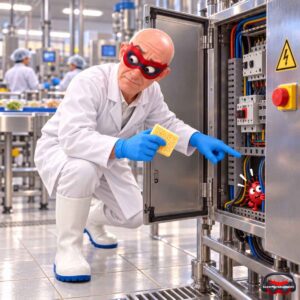
A clearly identified and trained person is needed, someone who can collect samples without contaminating them. This person often belongs to the quality team, but not necessarily to the laboratory. For me, the key skill is not only analytical. This person needs to know the site, the manufacturing processes and the ecology of the target microorganism: for example, Salmonella in a dry environment or Listeria in a wet environment.
“Our recommendation is to have around three quarters routine sampling and one quarter investigative sampling.”
How do you organize a sampling round?
At Sodiaal, we distinguish between routine points, which are useful for trend analysis, and investigative points. Our recommendation is to have around three quarters routine sampling and one quarter investigative sampling. The person can enter the production area with several sponges or wipes without yet knowing exactly where they will be used. If they see an air-conditioning leak, they take a photo, document the situation and collect a sample. If the result is positive, they then return to perform “vector samples”, meaning several samples around the initial point. We also plan sampling for abnormal situations: construction work, opening a wall, breaking a floor, bringing equipment into an area or a planned break in hygiene zoning. These scenarios should be prepared before a crisis occurs.
How do you manage results and trends?
For now, the first thing we are working on in production sites is digitalization. Results need to be entered into a LIMS or a database so that they can be used properly. Excel can be useful, but it quickly becomes limited when you need to visualize many sampling points, compare different zones and respond quickly. Then, we try to connect the data with other systems, particularly ERP systems, and create trend analyses and more readable interfaces. But before talking about artificial intelligence or dashboards, we need to generate good-quality data. Attractive software cannot compensate for poorly selected sampling points or unreliable results.
Thank you to François for taking us into the production area and helping us better understand who is responsible for what.
Leave your questions in the comments… we’ll answer them!
References and further reading
• ILSI Europe — Processing environment monitoring in low-moisture food production facilities
• ACTIA — Good practice guide for surface sampling
• FSSC 22000 — Official presentation of the certification scheme